
Naoko Bishop
Oregon Licensed Psilocybin Facilitator
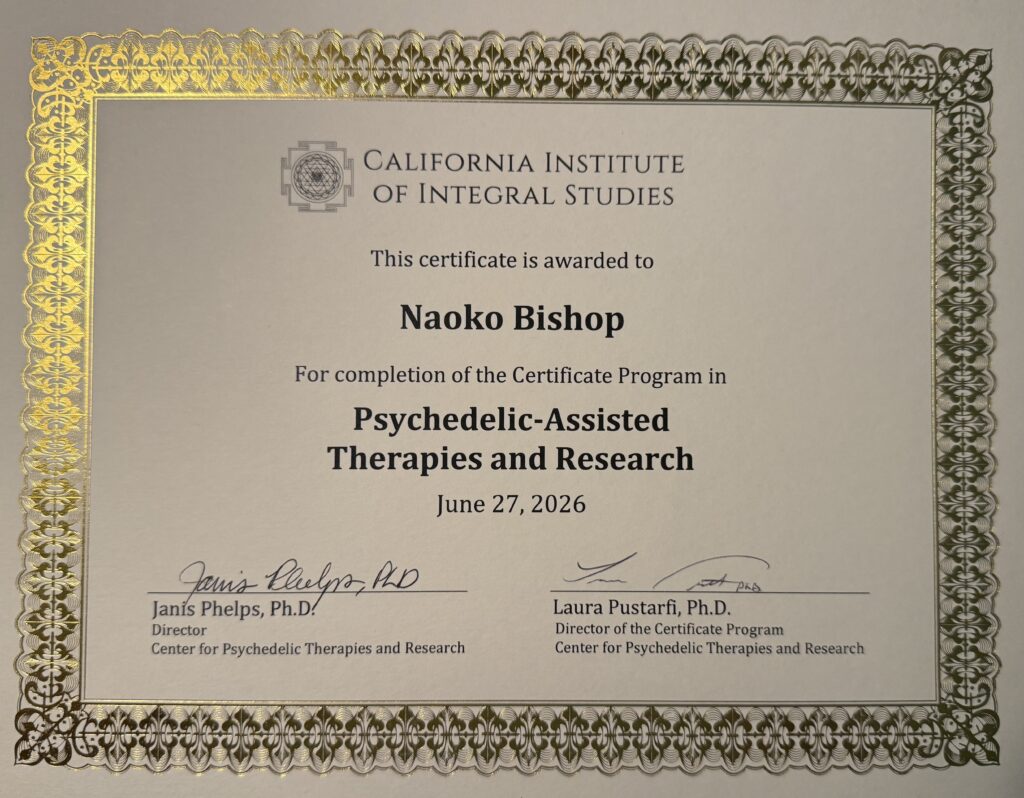
CIIS Psychedelic-Assisted Therapies and Research Certificate Graduate
Grof Legacy Training — Continuing Training, 2026 Cohort
Naoko Bishop is a Japan-born Oregon Licensed Psilocybin Facilitator who has supported more than 150 client sessions, including psilocybin sessions for more than 100 Japanese clients.
Her work is informed by Buddhist contemplative practice, her own personal psychedelic experiences, and years of study in transpersonal psychology, consciousness, and personal transformation in Japan. In 2026, she presented on psychedelic-related topics at the Japanese Association for Transpersonal Psychology and at Meiji University’s “Psychedelic Renaissance” program in Japan.
Having immigrated from Japan to the United States, she brings a personal understanding of what it can mean to navigate different languages, cultures, and systems of meaning. She is especially interested in offering culturally sensitive support to people from diverse backgrounds and those living across cultures.
Naoko completed the Psychedelic-Assisted Therapies and Research Certificate Program at the California Institute of Integral Studies (CIIS) and continues advanced training through Grof Legacy Training and ACER Integration’s 12 Trees Stewardship Training.
Certifications, Training, and Professional Development
- Psychedelic-Assisted Therapies and Research Certificate Program — California Institute of Integral Studies (CIIS), 2025–2026
- ACER Integration Program — Led by Dr. Rosalind Watts (2025)
- Psychedelics and Art Therapy — Level 2: Expanding the Journey — Charmaine Husum, RCAT, RTC, CT, DKATI (2025)
- The Theradelic Approach: Mastering Psychedelic Therapy for Profound Healing — Sunny Strasburg, LMFT (2025)
- Somatic Psychedelic Facilitation Training (2024)
- Zendo Project Psychedelic Peer Support Training (2024)
- Advanced Reiki, Level III — Japan Reiki Association (2024)
- Oregon Licensed Psilocybin Facilitator — Oregon Health Authority (2024)
- Synaptic Institute — Oregon state-approved facilitator training program in Entheogenic Medicine (2023)
In Progress
- Grof Legacy Training — Levels I & II Completed; Continuing Training, 2026 Cohort
- ACER Integration — 12 Trees Stewardship Training — Current Trainee
Presentations
- Speaker, Global Psychedelic Week, “Expanding Access: Minorities, Psychedelics & Inclusive Healing Spaces” (2025)
- Speaker, International Symposium “Inquiring the ‘Psychedelic Renaissance’ from Anthropology and Interdisciplinary Humanities,” Meiji University, Tokyo (2026)
“What Happens After the Psychedelic Experience?” - Speaker, “Psychedelic Renaissance,” Meiji University, Tokyo (2026)
My Path to This Work
I was born and raised in Japan, and my interest in consciousness, spirituality, and human transformation began long before I entered the psychedelic field.
I studied sculpture and ancient Indian art at Tama Art University, where I became interested in symbolism, spirituality, and the ways art can express experiences that are difficult to put into words.
A period of spiritual emergence in my own life led me to study transpersonal psychology and altered states of consciousness. Around the same time, I became interested in visionary art, including the work of Pablo Amaringo, which deepened my curiosity about symbolic imagery and the inner landscapes that can arise in non-ordinary states.
Over the years, I explored Buddhist meditation and contemplative practice in India, Thailand, Bhutan, and Plum Village in France. In Japan, I also studied transpersonal approaches, worked in holistic health settings, and became deeply interested in permaculture—not only as an ecological practice, but as a way of thinking about relationship, balance, and connection with the natural world.
My own experiences with psychedelics gradually became another part of this longer exploration of consciousness and transformation. They also strengthened my respect for the importance of preparation, context, and integration.
After immigrating from Japan to the United States, I became increasingly aware of what it means to live between languages and cultures. This experience has shaped the way I work with people from different backgrounds and has deepened my interest in culturally sensitive support.
For me, the psychedelic session itself is only one part of the process. What happens before the experience, and how it is understood and integrated afterward, can be just as important.
My role is not to define what a client’s experience means, but to help create a respectful and supportive space in which they can explore it in their own way, at their own pace.